
Buying property in Oman as a foreigner is less about “finding a deal” and more about following the correct pathway: where you can legally own, what documents you must verify, and how to structure payments and due diligence so you don’t inherit hidden risk, especially if you plan to invest in Oman property as a foreigner.
This guide is a practical, step-by-step roadmap designed for non-Omani buyers. It focuses on the actions that protect you: verifying eligibility before you shortlist, understanding the documents you’ll encounter, running a structured due-diligence checklist, and budgeting beyond the headline price. Where legal interpretation is required, this page stays high-level and points you to the dedicated laws article, so you can separate “how to buy” from “what the law says” without mixing the two.
Here, the aim is simple: help you move from “I want to invest” to “I can execute safely,” with checklists you can follow and questions you can ask before you commit.
If you want the full end-to-end framework (ownership rules, costs, timeline, and due diligence checkpoints), see the complete investment guide.
Yes, but only under specific legal frameworks, and the “right you get” depends on who you are (GCC vs non-GCC) and where the property is located. For most non-Omani individuals, Oman ITC property ownership is the main pathway: ITCs (Integrated Tourism Complexes) are designated developments where ownership rules for Omanis and non-Omanis are set out under the ITC ownership law.
If you’re buying property in Oman as an expat, treat this as an eligibility check before you do anything else (viewings, deposits, or negotiations). The Ministry of Housing and Urban Planning also runs official e-services related to the Real Estate Registry, which is where ownership/registration processes are handled.
In Oman, “foreign ownership” is not one single thing. At a high level, it typically falls into one of these buckets:
Practical takeaway: before you assume a listing is “buyable,” verify which legal regime applies (ITC vs restricted area vs other permitted arrangements). This guide stays focused on the how-to execution path; the detailed legal breakdown (decrees, zones, ownership types, and what each right includes) belongs in the dedicated “Oman property laws for foreign investors” article.
Oman’s legal landscape distinguishes between different categories of foreign buyers:
What this means for you as a buyer: your first step is not “pick a unit,” it’s confirm your eligibility pathway (ITC eligibility, zone restrictions, and registry pathway). The official Ministry site provides access points to Real Estate Registry e-services, which is where ownership-related processes are handled on the government side.
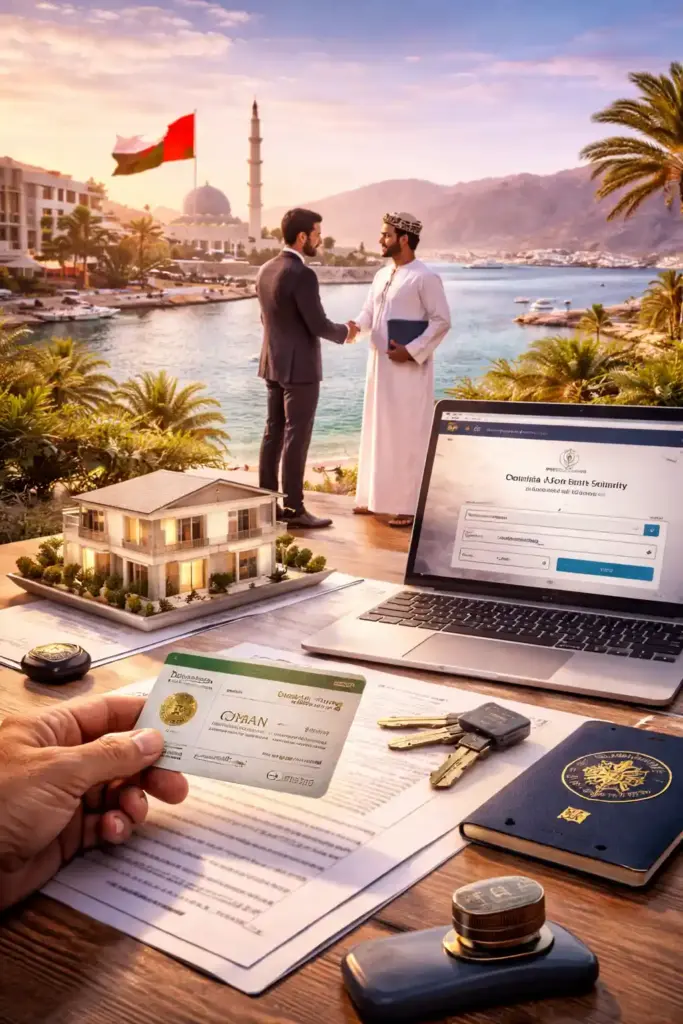
For most non-Omani buyers, the “where” question behind can foreigners buy property in Oman comes down to a single legal concept: Integrated Tourism Complexes (ITCs). If you want to Invest in Oman Property as a Foreigner, you should first confirm that the unit you’re considering sits inside a properly licensed ITC (or another explicitly permitted framework), before you spend time comparing layouts, prices, or payment plans.
ITCs are designated developments where non-Omanis are permitted to own property under the ITC ownership law issued by Royal Decree 12/2006. That’s the core legal basis behind Oman ITC property ownership, and why ITC status is the first filter you apply when shortlisting.
Outside that framework, ownership rules can change significantly depending on the area (including zones where non-Omani ownership is prohibited under separate legislation).
Don’t rely on marketing labels like “freehold” or “expat-friendly.” Verify designation and licensing.
Use this verification checklist:
When researching Muscat in particular, you’ll frequently see ITC communities referenced by investors and advisors. Treat these as examples to orient your research, not endorsements:
This is the practical flow most foreign buyers follow, from shortlist to ownership registration. The aim here is to help you execute safely, not to debate law. Keep your process simple: verify eligibility first, then validate the asset, then only pay when paperwork and terms are clear.
Step 1: Shortlist the right type of deal (developer vs resale).
Start by deciding whether you’re buying from a developer (often off-plan or newly delivered) or from an existing owner (resale). Your risk profile and timeline will differ. At this stage, don’t fall in love with finishes, collect facts: unit specs, handover timeline, community rules, and any fees that will affect your holding costs. A smart shortlist also includes your “must-have” rentalability signals (parking, connectivity, amenities), because these influence how quickly the unit can be leased when you invest in Oman property as a foreigner.
Step 2: Viewings: ask the questions that prevent expensive surprises.
Before you pay anything, use viewings to validate “deal reality.” Confirm what’s included, what condition the unit is in, whether there are ongoing construction impacts nearby, and what recurring community charges look like. Practical leasing execution matters too: units that are presented well (cleaning, repairs, strong photos) typically rent faster, while overpricing can increase vacancy time—both directly affect your real-world returns.
Step 3: Due diligence (legal + technical + financial).
This is the step that separates “buyers” from “owners.” Your checklist should cover (1) ownership evidence and authenticity of title/registration records, (2) any encumbrances or claims on the property, and (3) technical condition that could turn into immediate repair costs. The core idea is simple: you verify the asset and the paper trail before you commit money.
Step 4: Reservation + deposit: understand what you’re paying for.
A reservation fee or deposit is commonly used to hold the unit and move the transaction forward. What matters is not just the amount, it’s the terms: when, as you Invest in Oman Property as a Foreigner, it becomes non-refundable, what it applies toward, and what conditions allow a refund. Any deposit should be backed by clear written terms, not informal messages.
Step 5: Contract signing + payment schedule: treat the paperwork like the product.
For most foreign buyers, the contract and payment milestones are where risk hides. If you plan to Invest in Oman Property as a Foreigner, ensure the agreement clearly defines the parties, property details, price, payment timing, handover conditions (if applicable), and what happens if either side defaults. If you’re buying remotely, power of attorney (Wakala) may be used, make sure you understand scope and limitations before authorizing anything.
Step 6: Ownership transfer and registration: confirm the record is updated.
The finish line is not “keys,” it’s registration. The ownership transfer typically involves registering the buyer as the owner with the relevant real estate registration process so the official record reflects the change. This is the point where you verify that the transaction is complete in the registry, not just “done in practice.”
If you want a one-page checklist to validate your deal inputs (rent comps, vacancy and expenses) before committing, use the ROI evaluation checklist we built for Muscat.
When you buy property as a foreigner, you’re not just buying a unit, you’re buying a paper trail that proves the asset can be transferred cleanly and registered correctly. The safest approach is to separate documents into three buckets:
If you want a broader, investor-friendly overview of the overall journey (without getting lost in legal jargon), you can follow this practical roadmap to the Oman buying journey while you collect the documents below.
Most sellers, developers, and service providers will request clear identification documents early, because these become part of the compliance and registration workflow. Typically, you should be ready to provide:
If you’re using a representative (for example, you’re abroad during signing), a properly scoped power of attorney may be part of the process. Don’t treat this as paperwork trivia, your authorization defines who can sign and what they can commit you to.
This is where foreign buyers most often get blindsided: a listing can look fine, but the documentation might be incomplete, inconsistent, or unclear. Before you pay any meaningful amount, request documents that let you verify, especially if you Invest in Oman Property as a Foreigner:
If the seller can’t provide a clean, consistent set of property documents, that’s not a “small delay”, it’s a risk signal you should take seriously.

Once you move from “interested” to “committed,” your focus shifts to transaction documents and the registration trail, because the finish line is not receiving keys, it’s ensuring the ownership record is properly updated.
Common categories here include:
A simple way to keep control: use a “document-first” mindset, every payment should match a written clause, and every clause should map to a document you can verify later.
The headline price is only the start. If you’re looking to Invest in Oman Property as a Foreigner, a cleaner way to budget is to split costs into three layers:
Most deals include an early payment to reserve the unit or progress the transaction. The key isn’t the label (“reservation fee,” “booking deposit,” etc.)—it’s the conditions attached to it:
Budgeting tip: treat the deposit as a risk-sensitive cost, not just a “first installment.” If the terms aren’t written clearly in the agreement, you’re not budgeting—you’re gambling.
Even when everything else is smooth, you should assume there will be costs tied to the ownership transfer and registration trail. These are the costs that tend to show up around:
Budgeting tip: plan for these costs as a separate line item (not bundled into “misc”). That keeps your real “all-in” investment number honest—and prevents later surprises from distorting your ROI calculation.
Not every purchase needs every professional. But some fees are cheaper than the mistakes they prevent:
Natural next step for investors: once you have your “all-in” number (price + the layers above), you’ll want a clean way to test assumptions like vacancy, expenses, and financing impact— that’s where the Muscat ROI evaluation checklist becomes useful (it keeps the math grounded without turning this page into a yield article).
Foreign buyers may be able to finance a property in Oman, but eligibility depends heavily on factors like residency status, employer profile, income documentation, and, most importantly, whether the property itself fits the bank’s lending criteria. Some local banks explicitly market housing finance products for expatriates, which is a practical signal that expat financing exists (subject to requirements and bank approval) when you Invest in Oman Property as a Foreigner. For example, Sohar International publishes a dedicated “Housing Finance for Expatriates” product page with required documentation, and Oman Arab Bank notes housing loan terms “for Omanis and Expats alike.”
Option 1: Cash purchase (simplest execution).
Cash removes lender constraints, but it does not remove due diligence. Your “financing work” becomes budgeting for all-in costs and timing.
Option 2: Developer payment plan (common alternative).
Some developers offer staged payments. Treat this as financing-by-schedule: you still need to stress-test affordability and contract terms, but there’s no bank underwriting.
Option 3: Bank mortgage (possible, but conditional).
Banks will typically require a structured set of documents (identity/residency proof, salary evidence, bank statements, valuation reports, and property documents). Sohar International lists examples of required documents for expatriate housing finance (e.g., residence card, salary certificate, bank statements, valuation report, title deed/krooki, and purchase agreement).
Quick eligibility factors lenders commonly assess (what to prepare)
Mortgage process checklist (short and practical)
Due diligence is where you protect your downside. As a foreign buyer, your goal is not to “collect paperwork” it’s to verify the property can be transferred cleanly, that there are no hidden legal/financial obligations, and that your assumptions about renting and costs are realistic. Use the checklist below before you commit to any irreversible payment in any Oman ITC property ownership transaction.
| H3 Topic | What to Verify | What to Ask For | Red Flags |
|---|---|---|---|
| Title & ownership checks | Confirm the seller’s legal right to sell; check boundaries and whether the property is free of claims/encumbrances. | Title/ownership evidence, registry confirmation, any documents showing the property is transferable. | Missing/unclear ownership proof; conflicting property identifiers; any sign of unresolved claims. |
| Project licensing & handover risks | Validate project status and approvals; for off-plan, confirm timeline realism and handover conditions. | Project approvals/licensing evidence; handover timeline clauses; snagging/defect responsibility in writing. | Vague handover commitments; unclear penalties; no clarity on defect handling. |
| Rental rules & community fees | Verify if there are restrictions on leasing; understand service charges and recurring fees that affect net returns. | Community/building rules; service charge schedule; any leasing restrictions in writing. | “You can rent it easily” claims with no written rules; unclear or escalating fees. |
| Red flags that should stop the deal | Anything that blocks transfer, hides liabilities, or relies on verbal promises. | Written confirmation for every critical point; clear payment/receipt trail. | Pressure to pay quickly; refusal to share documents; inconsistent answers; “trust me” sales tactics. |
Buying is only half the story. After completion, results depend on three practical realities: how efficiently you can rent the unit, how clean your documentation trail is if you resell, and how clearly you’ve planned for transfers (including remote signing and succession scenarios). The points below are grounded in standard Oman transaction practice and registry workflows, plus common deal documentation (sale agreements, ownership/title evidence, and power-of-attorney use) and day-to-day leasing execution checklists used by operators in the market, especially where Oman ITC property ownership is involved.
Renting performance is mostly operational execution. A “good” unit can still underperform if it’s priced unrealistically, presented poorly, or shown inflexibly. Focus on the levers that shorten vacancy time and reduce tenant churn:
Resale tends to go smoothly when you protect the “paper trail” from day one. Future buyers will ask for the same clarity you needed: proof of ownership, fee status, and confidence that transfer is possible without surprises. Make your resale future-proof by keeping a clean, verifiable record set:
A simple rule: if a document influenced your decision, keep it in a format that a future buyer can verify quickly.
Don’t treat transfers as a “later” problem. If you buy with a spouse/partner, use a representative to sign remotely, or expect changes in circumstances, clarify transfer mechanics early, an essential safeguard when you Invest in Oman Property as a Foreigner, especially after answering can foreigners buy property in Oman for your specific case, using written, document-led decisions rather than assumptions.
At minimum, confirm:
If you’re a foreign buyer, Oman isn’t a “browse listings and buy” market, it’s a pathway market. The safe workflow for Oman ITC property ownership is:
Sometimes, but you should assume “not automatically” unless you have written confirmation that your target area and ownership structure are legally permitted for non-Omanis. The safest approach is to treat ITC designation (or another explicitly allowed framework) as a non-negotiable filter before buying property in Oman as an expat.
Not always, and this is exactly why you shouldn’t rely on social media claims or sales talk. Some counterparties may request residency-related documentation as part of compliance and registration workflows, and requirements can differ by transaction type and structure. The correct move is to ask early, especially when you Invest in Oman Property as a Foreigner: “What exact buyer documents are required for registration in this deal?”
The safest payment setup is the one that is fully documented and traceable, where:
Avoid “pressure payments” (pay-now-to-hold-it) unless the reservation terms are written and specific: what the payment secures, when it becomes non-refundable, and how it applies toward the price. A practical rule: if you can’t explain in one sentence what you’re paying for and what happens if the deal stops, you’re not ready to pay.
If anything about the deal is non-standard, remote, off-plan, time-sensitive, or unclear, legal review is usually worth it. A good legal reviewer helps you validate:
If your strategy is to move quickly but safely, a legal reviewer acts like a brake system: you don’t “use it” to go slower; you use it so you can go faster without crashing.
Ready to shortlist options inside Muscat ITC communities? Explore curated opportunities on our main page.